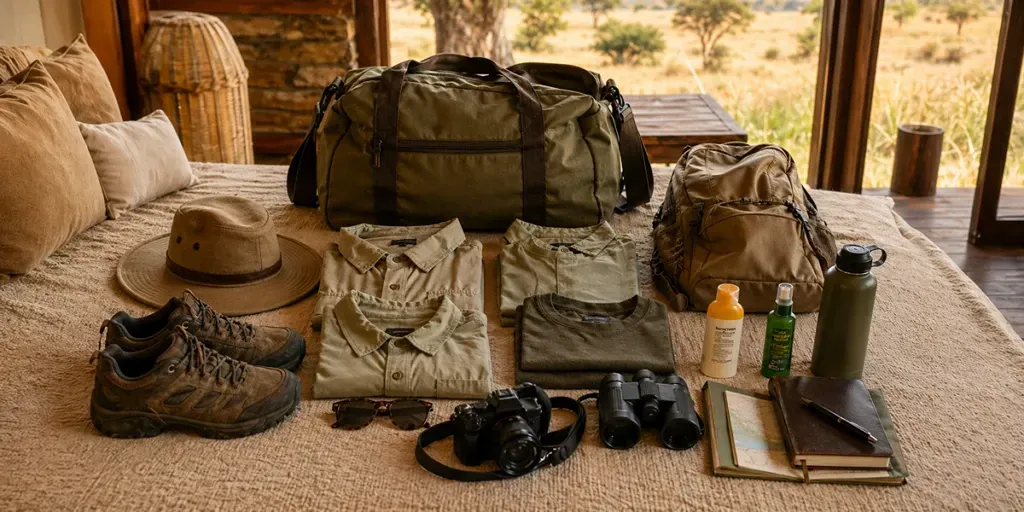
A Tanzania bush safari can take you from the open plains of the Serengeti to the highlands of Ngorongoro, the baobab landscapes of Tarangire and remote tented camps deep in the wilderness. Packing correctly means being prepared for cool mornings, hot afternoons, dust, sunshine, occasional rain and long game-drive days. 1. Safari Clothing/Think in Layers Safari days often begin early, sometimes around sunrise when temperatures can be surprisingly cool. By midday, conditions can become considerably warmer. Bring lightweight, breathable clothing that can easily be layered. Long-sleeved shirts and lightweight trousers are particularly useful because they provide additional protection from the sun, dust and insects. Neutral and earthy colours such as khaki, beige, olive, brown and grey are practical choices for the bush. Very bright colours aren't necessary, especially when participating in walking or nature-based activities. A useful clothing selection includes lightweight shirts, comfortable trousers, T-shirts, a fleece or sweater, a light jacket, underwear, socks, sleepwear and something comfortable for evenings at camp. 2. Prepare for Cold Safari Mornings One of the most commonly underestimated parts of a Tanzania safari is the temperature during early-morning game drives. Places at higher elevation, particularly around the Ngorongoro Conservation Area, can be quite cool in the morning and evening. Pack a fleece, sweater or lightweight insulated jacket that you can remove once the day warms up. If you're travelling during cooler months, an additional warm layer can make sunrise game drives much more comfortable. 3. Comfortable Shoes Are More Important Than Fancy Shoes For a standard vehicle-based safari, heavy hiking boots usually aren't necessary. Comfortable trainers or closed walking shoes are generally suitable. If your itinerary includes a walking safari, hiking, Lake Natron or other active experiences, stronger walking or hiking shoes may be appropriate. Sandals or lightweight casual shoes are useful around your lodge or tented camp. 4. Sun Protection Is Essential You'll spend many hours outdoors, often with the roof of your safari vehicle open. Pack a wide-brimmed hat, sunglasses with UV protection and suitable sunscreen. Lip balm can also be useful because wind, sun and dry conditions may leave your lips feeling dry. A reusable water bottle is another excellent safari companion. 5. Binoculars Can Completely Change Your Safari Experience Don't assume every animal will appear beside your safari vehicle.Lions may be resting far across the plains, elephants could be moving through woodland, and leopards may be high in distant trees. Binoculars make these encounters much easier to appreciate. They are particularly valuable for birdwatching and observing wildlife without needing to approach animals closely. 6. Bring the Right Camera Equipment Tanzania provides extraordinary opportunities for wildlife photography. If you're bringing a dedicated camera, consider a telephoto lens for wildlife and a wider lens for landscapes. Bring extra memory cards, spare batteries, chargers and protective storage. Even if you're using only your phone, make sure you have enough storage before your safari begins. Videos and wildlife photos can fill your phone surprisingly quickly. A power bank is useful during full-day game drives. 7. Protect Your Equipment From Dust Safari roads can become dusty, particularly during the dry season. A simple protective camera bag or dust-resistant pouch can help protect cameras, lenses and other electronics. Keep lens-cleaning equipment available rather than constantly wiping lenses with clothing. A lightweight scarf can also be useful when conditions become particularly dusty. 8. Pack a Small Day Bag Your main luggage normally stays at your accommodation or packed away in the vehicle. Keep a small backpack accessible during game drives containing your everyday essentials: binoculars, camera, phone, sunglasses, sunscreen, water bottle, tissues, personal medication and other small necessities. Avoid bringing an oversized backpack into the passenger area because space is valuable when everyone wants easy access to the windows and pop-up roof. 9. Personal Medication & Health Essentials Bring enough of any medication you regularly use for your entire trip, with some additional supply where practical in case of delays. Keep essential medication in your hand luggage when flying. For vaccinations, malaria prevention or other health requirements, travelers should seek advice from a qualified healthcare professional or travel clinic based on their itinerary and individual circumstances. 10. Insect Protection Mosquitoes and other insects are part of many tropical environments. Bring an appropriate insect repellent. Lightweight long sleeves and trousers are also useful around sunset and during evenings. Many safari accommodations provide mosquito nets or other protection, but carrying your own personal repellent remains worthwhile. 11. Toiletries and Keep Them Simple You don't need to bring your entire bathroom. Useful personal items include toothbrush and toothpaste, deodorant, moisturizer, lip balm, sunscreen, insect repellent, hand sanitizer, tissues and other personal hygiene products. Many lodges provide basic toiletries such as soap and shampoo, although what is supplied varies between properties. 12. Travel Documents Keep your essential documents together and somewhere secure. These may include your passport, visa documentation where applicable, travel insurance information, flight confirmations, accommodation information and safari documents. Keeping secure digital copies of important documents can be useful if the originals are lost. 13. Understand Safari Luggage Restrictions This becomes especially important if your itinerary includes domestic or bush flights. Small safari aircraft may have stricter baggage allowances and different bag requirements than international airlines. Soft-sided bags are often easier to load into safari vehicles and smaller aircraft. Don't assume your international airline's baggage allowance applies to your safari flight. Always check the exact allowance with the airline or your safari operator before departure. 14. A Soft-Sided Safari Bag Is Usually More Practical Large hard-shell suitcases can be difficult to fit into safari vehicles and small aircraft. A soft duffel or flexible travel bag is often the most practical choice because it can fit more easily into limited luggage compartments. Packing cubes can help keep clothes organized without adding much weight. 15. Bring Something for the Drive Safari isn't only about arriving at the destination. Some transfers between parks can take several hours. Consider carrying headphones, a book, downloaded music or another lightweight form of entertainment. However, don't spend the entire journey looking at your phone wildlife and interesting scenery can appear even outside the main game drive areas. 16. Prepare for Limited Connectivity Some safari camps are remote. Wi-Fi and mobile coverage may be available in certain locations but unreliable or unavailable in others. Download important information before leaving town, including flight information, accommodation details and anything else you may need offline. A safari can also be a great opportunity to disconnect for a while. 17. Bring the Correct Charging Equipment Tanzania commonly uses Type G electrical sockets, the three rectangular-pin style also used in the UK. An international travel adapter is therefore useful for many visitors. If you're travelling with several electronics, keep your camera charger, phone charger and power bank together so nothing gets left behind when changing camps. 18. Laundry Can Help You Pack Lighter Many safari lodges and tented camps offer laundry services, although availability, pricing and what items they accept vary. For a longer safari, this means you may not need a completely different outfit for every day. Packing fewer versatile clothes can make moving between camps much easier. 19. Rain Protection Depends on the Season If your safari falls during a wetter period, include a lightweight waterproof jacket or poncho. A waterproof cover for your small backpack can also help protect cameras and electronics. Weather can change quickly, so lightweight rain protection is more practical than carrying bulky waterproof equipment. 20. Don't Forget Your Zanzibar Extension If you're combining safari with Zanzibar, your packing list changes slightly. Add lightweight beach clothing, swimwear, sandals, beach-appropriate sun protection and suitable clothing for exploring local communities and Stone Town. Rather than packing completely separate wardrobes, choose lightweight pieces that can work for both safari evenings and your beach stay.

All guides
Serengeti National Park Tanzania
Packing for the Wild: Your Tanzania Safari Essentials
Pack smart for Tanzania: layer for cool Serengeti mornings and hot afternoons, pack khaki clothing, binoculars, and a telephoto lens. Essentials include sun protection, insect repellent, a soft-sided bag, and a daypack for game drives. Prepare for dust, limited Wi-Fi, and cool Ngorongoro temps.
rafikitembotours
Jul 26, 2026
Ready to plan your Tanzania safari?
Explore a variety of safari packages and compare trusted tour operators to find the perfect Tanzania safari for your next adventure.
Related guides
Climb Kilimanjaro

Gomberi Travel
Tanzania Local Tour Guide

Peter Kinyaiya
 Mt Kenya National Park
SAFARI IS MORE THAN SEEING THE BIG FIVE
rafikitembotours
 Gombe National Park
5 THINGS TRAVELERS SHOULD CHECK BEFORE BOOKING ANY TANZANIA TOUR
rafikitembotours
 Mt Kenya National Park
WHY SEPTEMBER IS ONE OF THE BEST MONTH TO TRAVEL IN TANZANIA AND KENYA
rafikitembotours
 Mt Kenya National Park
SERENGETI OR MASAAI MARA?HERE'S WHAT MAKES THEM DIFFERENT
rafikitembotours