
Deciding between Kenya and Tanzania for a "Green Season" safari depends heavily on which stage of the Great Migration you wish to witness and your tolerance for rainfall. While both countries share a border, their ecosystems respond differently to rainfall between November and May.
Comparison Overview
| Feature | Tanzania (Green Season) | Kenya (Green Season) |
|---|---|---|
| Peak Months | Jan – March (Calving) | Nov – Dec & April – May |
| Primary Event | Wildebeest Calving (Southern Serengeti) | Resident wildlife & Migratory Birds |
| Rainfall Intensity | Moderate to Heavy (esp. April/May) | Generally lighter showers than Tanzania |
| Crowd Levels | Very Low (except Ndutu area) | Extremely Low |
| Top Landscape | Emerald plains of the Serengeti | Lush hills of the Maasai Mara |
| Best For | Predator action & Newborn animals | Solitude & Photography |
Tanzania: The "Calving" Powerhouse
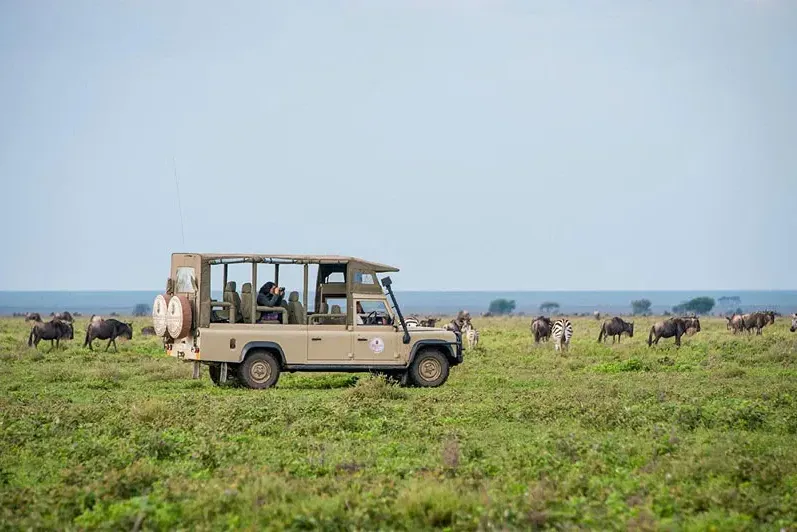
Tanzania is generally considered the "winner" for Green Season travelers, especially for the Ndutu and Southern Serengeti regions.
- The Draw: Between January and March, the herds are stationary to give birth. This creates a high-density wildlife spectacle that Kenya cannot match during these specific months.
- The Landscape: The Ngorongoro Crater remains spectacular and lush, though it can get misty.
- Logistics: The "Long Rains" (April–May) are more significant in Tanzania; remote bush tracks can become challenging.
Recommended Lodges (Tanzania)
1. Lake Masek Tented Lodge (Ndutu): Perched on the shores of Lake Masek, this is the "ground zero" for the calving season. It offers front-row seats to the herds from December through March.
2. Namiri Plains (Eastern Serengeti): This area was closed to the public for 20 years to allow cheetah populations to thrive. In the green season, the short-grass plains attract the herds, making for world-class predator sightings.
3. Gibb's Farm (Karatu): A beautiful retreat near the Ngorongoro Crater. During the green season, their organic gardens are at their peak, and they serve as a cozy, misty base for crater floor descents.
Kenya: The "Quiet Secret"
In Kenya, the Green Season is often called the "Secret Season." Since the herds are usually in Tanzania early in the year, Kenya relies on its exceptional resident wildlife.
The Draw: You get the Maasai Mara almost entirely to yourself. Big cats (lions, leopards, cheetahs) are territorial and do not leave, so sightings remain excellent.
The Landscape: The Mara’s rolling hills turn a deep, photogenic green. It is the best time for "clean" backgrounds in photography.
Logistics: Kenya’s infrastructure is very robust; many conservancies offer all-weather airstrips.
Recommended Lodges (Kenya)
1. Angama Mara (Maasai Mara): High on the Oloololo Escarpment, this lodge offers views that are even more dramatic when the plains below are vibrant green. They often have attractive "long stay" offers during the low season.
2. Olare Mara Kempinski (Olare Motorogi Conservancy): Located in a private conservancy, this lodge offers high-end luxury with almost zero vehicle traffic during the green months.
3. House in the Wild (Enonkishu Conservancy): A more intimate, family-run option on the banks of the Mara River. It's excellent for seeing how local communities and wildlife thrive during the lush rainy season.
Summary: Which Should You Choose?
With both countries offering unique experiences, consider these final recommendations to guide your decision.
Choose Tanzania if...
You want to see the Great Migration. To see the herds during the Green Season, you must be in Tanzania. It is the only place to witness the "circle of life" with thousands of calves being born and predators lurking nearby.
Choose Kenya if...
You want absolute solitude and luxury. While you won't see the massive 1.5 million-strong wildebeest herds, you will have intimate encounters with the "Big Five" without the convoy of vehicles typical of the July–September peak season.
Travel Pro-Tip: The "Short Rains" Bridge
In November and December, both countries experience the "Short Rains." During this window, the herds are often moving through the Eastern Serengeti and Loliondo, making it an ideal time for a "Cross-Border" safari that touches both the Maasai Mara and the Serengeti.
.jpg_1784962360143.webp?color=cac6b6%2C908d57&width=601&height=376)

.jpg_1784965072251.webp?color=c3cbcd%2C302c10&width=601&height=376)